Captain Hoxa’s disappearance in the 1918 bombardment
The Reincarnationist PapersCaptain Hoxa’s disappearance during the 1918 bombardment is a wartime mystery with no confirmed resolution: after running toward the fire, he was never found. Vasili Arda witnesses the captain leave, then later recounts the failed search and the ghost stories that grew from Hoxa’s absence.
The bombardment
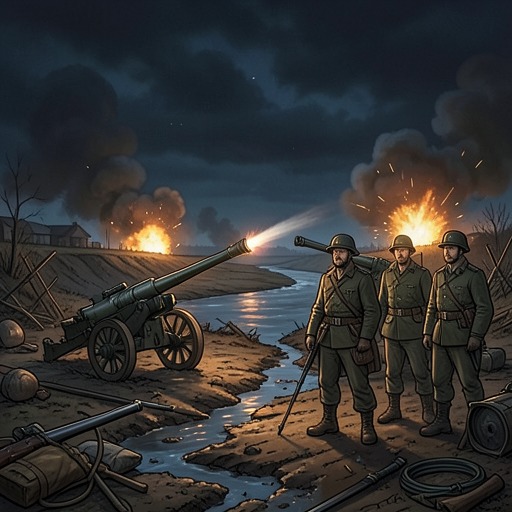
As the bombardment continued, Hoxa ordered his men to reload and fire at will, urging them to hurry while watching the explosions through field glasses. Shells struck the French camp and the fire held around three hundred yards away for several minutes, as neighboring companies brought their guns to bear. The men around Vasili kept loading and firing at a feverish pace; in the confusion, Vasili alone noticed that the captain’s attention had fixed on something beyond the guns.
Hoxa dropped his glasses, drew his pistol, and ran toward the curtain of fire, shouting and aiming as he went. No one else among the soldiers saw him leave. His disappearance began not with an announced order or a witnessed final moment, but with a sudden movement that went unnoticed by everyone occupied with the bombardment. Vasili’s solitary observation would become crucial once the firing stopped and the captain could not be accounted for.
The search after dawn
The storm eased as dawn broke over the ridge. Exhaustion slowed the rate of fire until the guns fell silent. Survivors surveyed the damage and the dead, and several minutes passed before anyone asked where the captain was. Hoxa was nowhere in sight. Vasili told the soldiers that he had seen him run toward the blasted plain about an hour earlier, pointing out the direction.
A corporal sent Vasili and three other soldiers with him to search. They spread out through wet, knee-high grass and bushes, with Vasili attempting to retrace Hoxa’s route. Beyond roughly one hundred and fifty yards, the ground changed: the grass was flattened and scorched, and craters marked the shell impacts. At about one hundred and seventy-five yards, the mud became too deep to cross on foot. The search party was moving through a devastated stretch of ground, with the smoldering French camp farther on. The searchers found no sign that could explain where Hoxa had gone.
Vasili turned back while the other four continued looking for their leader. At the base of the rise, beneath the guns, he picked up Hoxa’s discarded binoculars, wiped mud from the lenses, and put them around his neck before returning to the remains of the camp. The glasses were a tangible trace of the captain, but they did not resolve the central question: whether Hoxa had reached the French camp, been lost in the bombardment, or gone somewhere else.
Retreat and unanswered fate
That morning, the company fell back on foot. Its draft horses, which had been tied beside the river, were gone; unable to pull their equipment, the soldiers left it behind and joined the first company. News of the armistice arrived later the same day. The retreat and the end of the fighting closed the immediate episode without bringing any news of Hoxa or allowing the search to establish his fate.
When Ramsay later asked what had become of the captain, Vasili recalled that the other four searchers returned covered in mud after more than an hour on the blasted plain. They had found no trace of Hoxa. The account preserves a sharp difference between what Vasili knew and what the group could confirm: he knew the direction in which Hoxa had run, but neither his sighting nor the recovered binoculars could establish what happened afterward.
From disappearance to legend
Hoxa’s fate remained unknown, but his name survived in stories. Vasili says that the captain became a legend and that the ghost stories persisted into the Second World War. He begins to recount what people said would happen whenever a Bulgarian unit was pinned down, but Ramsay interrupts to say he is already familiar with those stories. The legend therefore appears in the narrative not as proof of Hoxa’s death or return, but as the afterlife of an absence that the soldiers never explained.
The episode turns a battlefield event into an enduring uncertainty. The guns stop, the company retreats, and the armistice arrives, yet none of these developments answers the question raised when Hoxa ran toward the fire. Vasili’s memory supplies the last witnessed action; the failed search supplies no conclusion. In the gap between them, the missing captain becomes a figure repeatedly invoked in later military folklore.